Rituals are habits made holy
Oct 06, 2026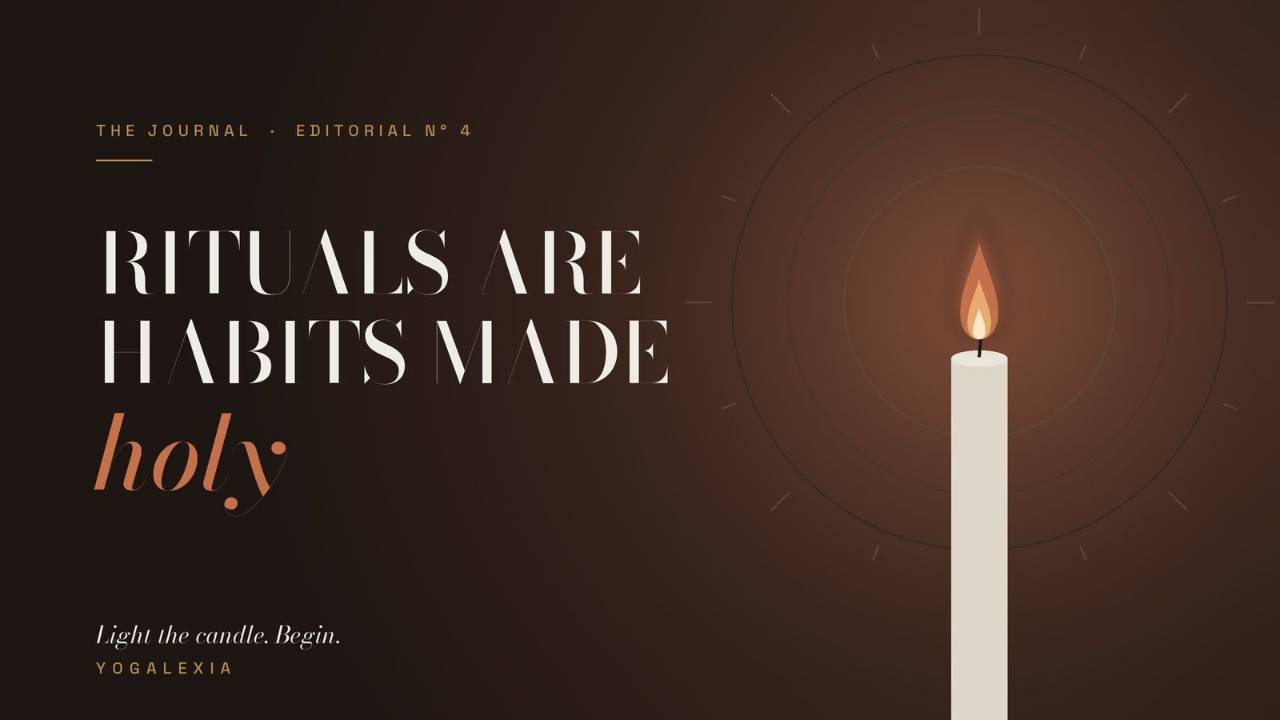
The Journal · Practice · Editorial N° 5
You already live by rituals. The coffee before anyone else is awake. The scroll before your feet touch the floor. The glass of wine that tells your body the workday is over. The question is not whether you have rituals. The question is what they are serving.
Most of what we call our routine is habit: actions repeated so often that the nervous system runs them on autopilot. That is not a flaw. Habit is a form of intelligence. It frees our attention for other things. But a habit has no address. It goes nowhere in particular. It simply keeps going.
A ritual is the same action with an address. The same tea, the same candle, the same twenty minutes on the mat. What changes is not the action. What changes is where you are when you do it, and who or what you do it for.
That is what I mean when I say: rituals are habits made holy.
Holy means whole
The English word holy comes from the Old English hālig, which shares its root with whole and heal. To make something holy, at the root, is to make it whole again. Not more pure. Not more spiritual. More complete.
And ritual comes from the Latin ritus, a word some scholars connect with the Sanskrit ṛta: the cosmic order, the rhythm by which the sun rises and the seasons turn. In that sense, a ritual is a small way of putting yourself back in rhythm with something larger than your to-do list.
The grooves we walk in
Yoga has its own word for habit: saṃskāra. Every action and every thought leaves an impression in the mind, like a footstep in wet clay. Repeat it often enough and it becomes a groove, and the mind runs into that groove all by itself. This is why change is so hard. We are not weak. We are well practised.
Patañjali does not ask us to fight our saṃskāras. He describes something far more elegant:
taj-jaḥ saṃskāro ’nya-saṃskāra-pratibandhī
The impression born of that deep absorption blocks all other impressions.Patañjali, Yoga Sūtra 1.50 (own rendering)
In plain words: you do not get rid of an old groove by staring at it. You cut a new one. With care, every day, until the water starts to flow there instead.
Everything can be an offering
The Bhagavad Gītā gives us perhaps the simplest instruction for turning habit into ritual. Kṛṣṇa does not tell Arjuna to leave his life and go to the forest. He says:
yat karoṣi yad aśnāsi yaj juhoṣi dadāsi yat
yat tapasyasi kaunteya tat kuruṣva mad-arpaṇamWhatever you do, whatever you eat, whatever you offer into the fire, whatever you give, whatever discipline you keep: do it as an offering to me.
Bhagavad Gītā 9.27 (own rendering)
Whatever you do. Whatever you eat. Not a special list of sacred acts. Everything.
The Tantric traditions go even further. In the Śiva Sūtras, the awakened practitioner is described in two lines I love for their sheer audacity:
śarīra-vṛttir vratam · The upkeep of the body is the vow.
kathā japaḥ · Conversation is mantra.Śiva Sūtra 3.26–27
Eating, sleeping, washing, speaking: for the one who is awake, all of daily life is practice. Tantra does not separate the temple from the kitchen. It asks you to carry the temple into the kitchen.
The anatomy of a ritual
In a traditional Tantric pūjā, nothing begins without a saṅkalpa, a spoken intention that names the time, the place and the purpose of the practice. And nothing ends without a closing, an offering back. Between the two, the most ordinary gestures, lighting a lamp, pouring water, placing a flower, become charged with meaning.
You can borrow this structure for any habit you already have:
- A threshold. A small sign that says: now. One breath, a bell, a match struck, hands washed.
- A saṅkalpa. One sentence. For what, or for whom, am I doing this?
- The act itself, fully. No second screen. Let the tea be tea.
- A closing. A bow, a word of thanks, a moment of stillness before you move on.
Four steps that turn twenty minutes on autopilot into twenty minutes of presence.
You don’t need more time
The women I work with rarely lack discipline. They lead companies, teams and households. What they lack is not time or willpower. It is the feeling that the hours they already have belong to them.
Ritual gives that back. Not by adding another task to the list, but by changing the quality of what is already there. Your morning coffee does not have to be replaced by a two-hour sādhanā. It can become the sādhanā. One conscious breath before the first sip. One sentence of intention. Drunk slowly, looking out of the window instead of into the phone.
This is not small. Repeated daily, it becomes a saṃskāra. And over months, that new groove carries you home.
A small practice
For the next seven days:
- Choose one habit you already do every day: making tea, showering, opening your laptop, lighting a candle.
- Before you begin, pause for one full breath and speak your saṅkalpa, silently or out loud. Keep it simple: This is for my clarity. This is for my body. This is for the Goddess.
- Do the act with your full attention, as if it were the only thing you will do today.
- Close with a moment of thanks.
- On day seven, ask yourself: did the habit change, or did I?
The holy was never somewhere else. It was waiting in the things you already do.
Light the candle. Begin.
Alexia
References
- Patañjali, Yoga Sūtra 1.50, on saṃskāra
- Bhagavad Gītā 9.27
- Śiva Sūtra 3.26–27, attributed to Vasugupta (9th c.), with Kṣemarāja’s commentary Vimarśinī
- On the etymology of holy (Old English hālig, related to whole) and ritual (Latin ritus)
✺
THE RITUAL · your monthly practice space
Come home, once a month.
A practice space for women who want depth without another thing on the list. Each month, four doors into the same ritual:
01
The Class
02
The Breath
03
The Audio
04
The Page
Doors open January 2027 · 7 days free, then €33 / month or €277 / year
LETTERS FROM YOGALEXIA
New editorials, rituals and practices, plus first access to retreats, trainings and pilgrimages. Straight to your inbox.
No spam, ever. Your details stay with us, and you can unsubscribe at any time.